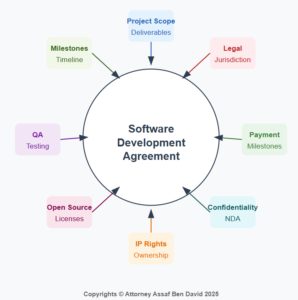
What should a software development agreement include?
A software development agreement should include: (1) a detailed scope of work describing features and deliverables; (2) a milestone-based payment schedule tying payments to completed phases; (3) an explicit IP ownership and assignment clause transferring all rights to the client; (4) open-source license compliance terms; (5) QA and testing responsibilities; (6) the number of permitted revision rounds per milestone; and (7) a dispute resolution clause specifying jurisdiction and process. Missing any of these elements exposes clients to lost IP, cost overruns, or unfinished projects.
What Is a Software Development Agreement?
A software development agreement is a legally binding contract between a client and a software developer (or development company) that governs the creation of custom software, a web application, or a mobile app. It defines: scope of work, deliverables, milestone-based payment schedule, intellectual property ownership, open-source license compliance, QA and testing responsibilities, revision rounds, and dispute resolution procedures.
Without this agreement, clients risk losing IP ownership, funds, or the ability to complete or commercialize their product.
- A startup paid $20,000 for an app, only to realize months later that the intellectual property (“IP”) was never transferred to the founders/startup but instead stayed with the developer. Later, when the founder was trying to get an investment, he had to pay an extra $15K just to get ownership that was really his to begin with.
- A team of developers was paid 70% of the project fee upfront but abandoned the project halfway through. The founders were left without the funds to complete the project elsewhere and with half-finished code that no one would touch.
- A web app was delivered, but the first version wasn’t what the founders envisioned. Disputes arose over who should pay for further revisions and corrections. The disputes led to threats, and the project was never completed.
Why a Software Development Agreement is Important
A software development agreement isn’t just another document – it helps to manage expectations, protect your interests and guide both sides on how the process should work. The agreement covers numerous topics such as the scope of work, project timeline, payment terms, intellectual property ownership, use of open-code, quality assurance (QA), rounds of corrections and how disputes will be resolved. Without a comprehensive agreement, even simple projects can spiral into costly, drawn-out problems.When Should You Use a Software Development Agreement?
Both clients and developers benefit from having a software development agreement in place. Clients are protected against IP disputes, abandoned projects, and unauthorized use of open-source code. Developers gain clear payment terms, defined scope, and protection against unlimited revision requests — reducing scope-creep disputes. As mentioned, this aligns expectations, helps avoid misunderstandings and clarifies issues such as IP ownership and payments. Additionally, as developers, this makes you look more professional. That said, if the value of the project is lower than the cost of the contract (common contracts for startups and their costs), then it might be enough to sign a shorter order form that covers the main issues (some of which are mentioned here below).Key Elements of a Software Development Agreement
1. Scope of Work and Project Description
It’s important to include a detailed description of the services and the project in the agreement. This usually appears as an annex (at the end). The more detailed the better because if later there’s any argument about what was supposed to be done – this section will help. It will also help with debates about IP ownership. If you don’t know all the details yet, add a description as best you can, and update the annex as things evolve (so long as both sides sign off on the updates).2. Milestones, Deliverables, and Rounds of Corrections
Misunderstandings often arise when project milestones are vague. It is crucial that each stage or milestone is clearly defined. This includes:- What each milestone includes (e.g., working prototype, full-feature app – which features…).
- The date of completion of each milestone/stage.
- How many rounds of corrections / revisions are included for each stage. For example, two rounds per milestone and additional rounds are at an hourly fee of X.
3. Intellectual Property Ownership – Make Sure It’s Yours
 One of the biggest mistakes founders make is assuming they automatically own the software their developer creates. In reality, ownership isn’t always transferred unless explicitly agreed upon.
What you need to include in the agreement:
One of the biggest mistakes founders make is assuming they automatically own the software their developer creates. In reality, ownership isn’t always transferred unless explicitly agreed upon.
What you need to include in the agreement:
- Full Ownership: Make sure that there is a section that states that you own all the code, designs, updates, and modifications developed as part of the project. Be careful of exceptions.
- Assignment of Rights: Developers must sign over and transfer any IP rights to the work, ensuring you’re the sole owner, and waive any moral rights. In some cases, the assignment might be connected to payment – which is something you need to review and be careful with.
- Third-Party Code: If open-source or third-party libraries are used, the agreement needs to state that the licenses allow the commercial use and modification of that code.
4. Payment Terms and Milestone-Based Payment Structure for Software Projects
Paying developers upfront might feel like a goodwill gesture, but it can lead to major issues if the project stalls. As a developer you’ll want to get at least some of the payment upfront. To protect yourself:- Milestone Payments: Divide the project into phases (e.g., wireframes, beta version, final delivery) and tie payments to the successful completion of each phase, stage or milestone. It’s ok for developers to ask for a small down payment – not all clients are fair or honest and they too need to protect themselves. But this shouldn’t be more than 5%-15% (the more expensive the project, the lower the % and vice versa).
- Retention of Final Payment: Hold back at least 20% of the total project fee until after a defined support period — typically at least 2–3 weeks for websites and 1–3 months for apps and custom software. This retention acts as a financial incentive for the developer to resolve post-launch bugs. After that period, agree in advance on a support fee.
- Approval Process: Clearly state that milestone payments require your written approval of the deliverables after they’ve been checked.
- A Copy of the Code: Always receive a copy of the code before or directly after making the last payment.
5. Open-Source Code and License Compliance
Developers often use open-source code to speed up development. While this is very common (it saves time and costs) – it has its’ risks if the right licenses aren’t used. To avoid mistakes, make sure that:- Relevant license: Any open-source code used has a license permitting commercial use and modification.
- Clear Documentation: Require developers to list all open-source components and their licenses.
- Limit: Where possible, limit the use of open-source code.